
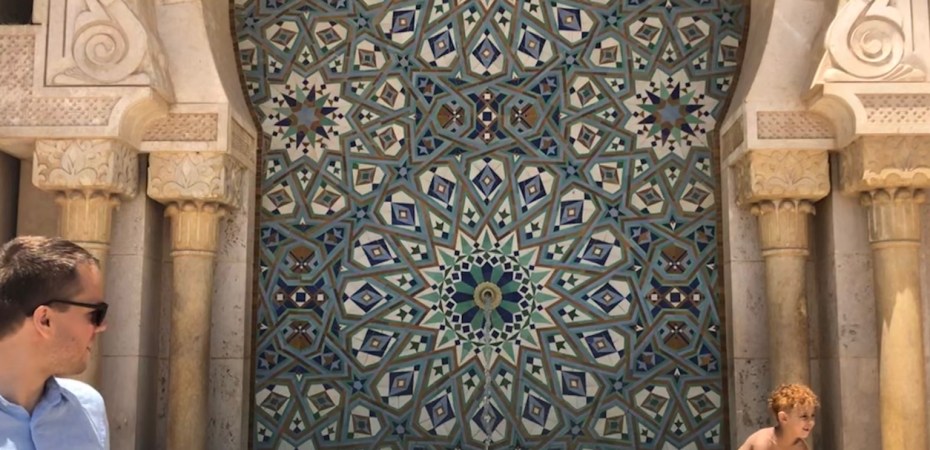
Before even embarking on our trip to Morocco, the food entranced me. I had never had it before, not even amongst the throngs of New York cuisine options, but I knew we were in for a culinary adventure.
Now that we’re back, the thing I miss most about visiting Morocco is the food.
Part I: As Salaam Alaikum
Regardless of the culture, which provided two layers of red tape to me given the language and my embodiment of a western woman, food was always warm and welcoming. There was never any tummy turmoil after eating the local cuisine–actually. Actually, the only bad experience I had was with eating sushi. Among the true Moroccan faire, nothing was ever sickening or pungent. We ate it most days, save for the dreadful sushi and the obligatory trip to McDonald’s. But most days, we opted to keep it authentic with Moroccan eats.
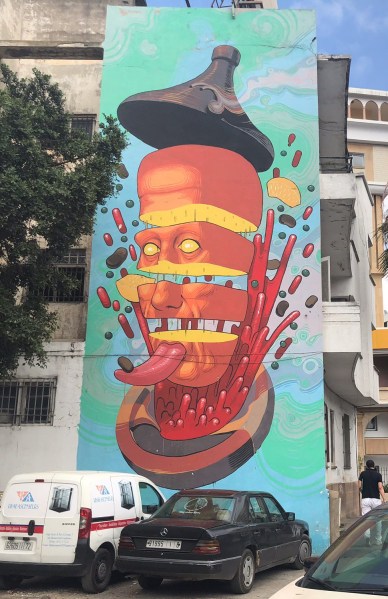
The hallmark of their cooking is the tagine. A hot clay pot with a conical lid, a tagine dish was always a good bet. It was brought to the table as a presentation. Still cooking in its juices as the waiter removed the conical top and unleashed the steam within. It was both flashy and humble, the embodiment of a full culture committed to modest rustic cooking that creates a masterpiece within each meal.
I tried quite a few tanginess, but the chicken with preserved lemon and olives dish became my go-to. The safety of this dish really surprised me. Normally I’d go for something far more adventurous. But it was comforting to find something so exquisite in a dish so simple.
Morocco is a country of many meats, exclusive of pork. There was lamb and beef, goat and sheep, and, in the coastal city of Casablanca, plenty of fish. Each of these options was able to adapt and evolve to fit into any meal, any time of day, beginning with breakfast.
In fact, my first meal there was a sizzling tagine of eggs with pulled beef chunks, served only after a bowl of oatmeal and olive oil, and aside the ubiquitous basket of bread, sweet fragrant mint tea, and glass of the most untainted fresh squeezed orange juice on the planet.
The astounding flavor that I was met with at this simple first meal, on our very first day of arrival, seemed a promising sign of the days to come.
As if kissed by the patron saint of paragon plates, dinner that night also faced me with food that was made with a mind-blowing attention to detail; a masterful dance of full natural flavors and powerful Moroccan spices. Three courses, fresh-made juice and tea; each element had such a strong and confident sense of itself that it would be hard to choose one as a favorite.
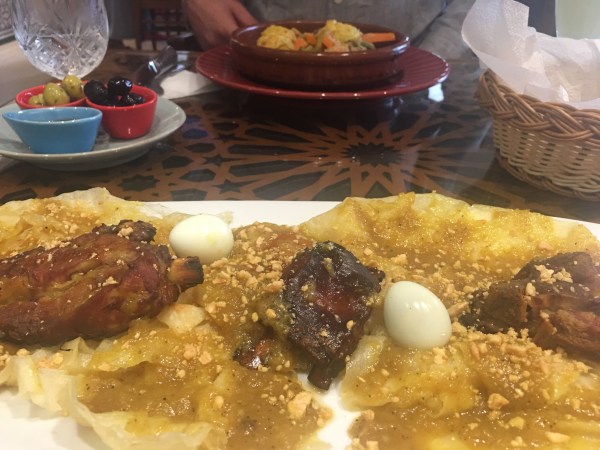
It was this evening that I had my first experience with local lamb. Three tender, juicy, and fragrant hunks of lamb atop sheets of gorgeous “tryd”–freshly made paper-thin dough reminiscent of a crepe, but lighter. An almost paste-like sauce smeared the papyrus-colored sheets which were also sprinkled with an element of crunch that, I guess, was almonds.
Our host taught us the proper way to eat Moroccan food. Not with a knife and fork, but with a slice of bread to soak up all the flavor of the sauce. In my case, all I needed was to wrap those delicate sheets around a hunk of lamb and enjoy.
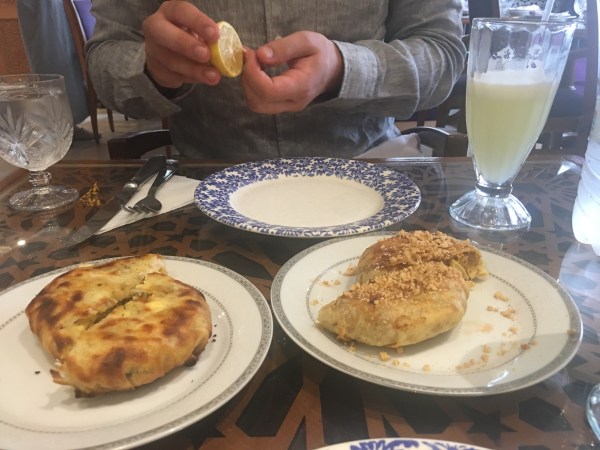
Call it foreshadowing, but even before I dove into hunks of melt-in-your-mouth lamb that were fit for an offering to Allah, a particularly inconspicuous and flavorful culprit met my mouth first: a pastilla appetizer packed with masterfully shredded and seasoned chicken. It wasn’t masking the flavor of the chicken or spicing it into oblivion as my culinary ventures had been apt to do in the past. In Morocco, they find a way to make each bite a dynamo of taste. There was cinnamon and turmeric and nuts and oil. The crust was flaky and the meat was moist; pillows of pleasure on a plate.
Without corn syrup or hormones, the chicken preserved its own integrity (even presumably having had its neck snapped and slashed in a busy market.) So after this first meal, I had been more open to rerouting my intentions of launching a lamb-dish inquisition and seeing what else chicken had in store.
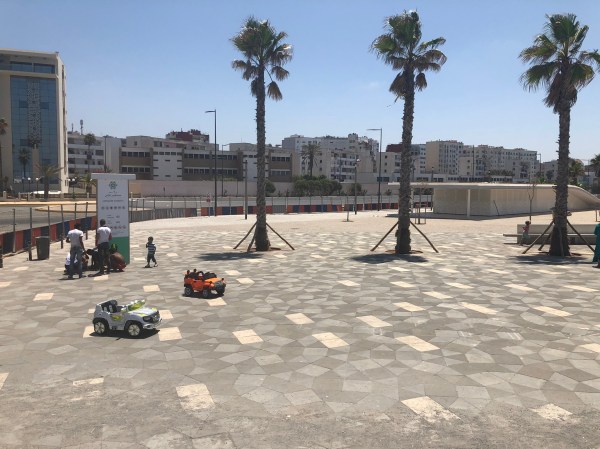
This dinner was close to the central part of town. The route to get their involved walking through the busy central square, awash with pigeons and child-sized remote-control Cadillacs for hire.
On our next night’s dinner, we went another direction. It was dusk when we made our trek, and the streets were surprisingly silent and sparse in comparison to the mayhem that was overflowing through the central square. It was more residential, and clearly more wealthy. A few blocks off our designated path was, literally, the palace of the King.
We walked through two alleyways that sent our street smarts into alarm (spoiler alert: it was totally safe, just unfamiliar), and eventually encountered a different type of bustling street. One long strip of road flanked on either side with homes, small shops like 99 cent stores, and walkup eatery counters seemed to make up the main drag of this side of Casablanca.
We took a left off of main drag and, opposite a small park and a mosque (can’t outrun God in a Muslim country) we took a table out front for dinner.
Since this country is Muslim, one particular norm of our typical vacation escapades was missing: alcohol. The bars in Morocco make it seem like an impending resurgence of speakeasies. Mostly only men go, and from the street, clubs and bars are practically shuttered up, without so much as a penetrable window or neon sign as an invitation to debauchery.
Instead, the country as a whole indulges in juice. There is juice everywhere, in every cafe, on every street, and in every flavor. The first one I encountered and would go on to have a love affair with throughout the week was lemon with ginger. Simple, exciting, and for a traveler with a susceptibility for motion sickness, comforting.
It was at this restaurant on the other side of town that Rich met his own exotic flavor muse: peach juice. We’re still not quite sure what the protocol for making their fruit juices was, but by the taste and texture of this peach concoction, it seemed that they simply juiced it to a smooth, slightly pulpy consistency and put it in a glass.
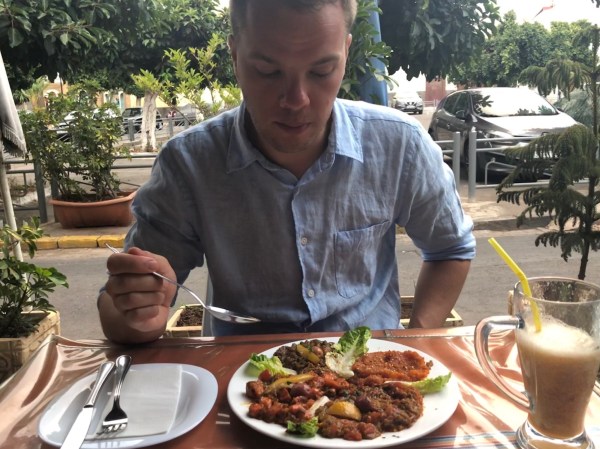
On this same night, I stuck with a sparkling water and, after looking over the menu, kept it slightly simple with my dinner, too. At least, that was the plan. It was the here that I had my first encounter with chicken tagine with preserved lemon and olives. Rich got something akin to skewers.
The food was pretty good. It wasn’t a sensational life changing experience like we’d had the night before. It didn’t feel overly exotic nor confronting. It simply was dinner. But I liked it. The whole vibe of a preserved lemon, somehow pickled in it’s own acidity breaking down the tough skin making it soft to eat, was ethereal. The olives, also, cooked into the juices, were ripe, juicy, and godly. The chicken, on this occasion, fell flat. Like its neck had been snapped a few weeks ago and it was salted to stay preserved.
Still, the lack of artificial flavors, hormones, or preservatives always left us with happily filled tummies and no sign of Montezuma seeking his revenge.
As we walked through our days and our nights, we became more and more familiar with what we were encountering and what we were ordering. French translations began to come second nature, and we knew what to look for even if we weren’t quite nailing the pronunciation.
On an overnight trip to the North, we caught a break.
 tarazine
[…] travel experience than staying in an AirBnB. We do it everywhere we go–Colorado, Mexico, and even Morocco. Going to Canada was no different. Though we booked through AirBnB (not an #ad), what we got was a […]
[…] I made it to that train. […]
[…] travel experience than staying in an AirBnB. We do it everywhere we go–Colorado, Mexico, and even Morocco. Going to Canada was no different. Though we booked through AirBnB (not an #ad), what we got was a […]
[…] I made it to that train. […]
[…] my love of chatting and researching into action substitute teaching at a local high school. All my adventures in life, all my countless internet sleuthing hours, finally feel like they amount to something. I […]
[…] >>>Begin the journey to Morocco from the beginning<<< […]
[…] past is a different sort of cerebral adventure. It’s more psychedelic to read history–arts! culture!–with its intrigue and […]